
10 Chinese Words for Texture That English Doesn’t Really Have
From 啃鸡爪 and 嗑瓜子 to Q弹, 酥, 糯 and 爽: a guide to the Chinese language of texture.
My Chinese is far from perfect. But when I’m talking about food, I sometimes find myself using Chinese because English doesn’t quite have the right single word.
The more Chinese I learn, the more I notice this. English has plenty of words for describing food, but compared with Chinese, our everyday vocabulary for texture feels surprisingly limited, and where Chinese might have a single word, English needs a phrase or sentence.
Languages tend to develop precise words for things that are important to that culture. The most famous example, of course, is the Inuit’s many words for snow, or German’s unique terms for very specific emotions, whereas Chinese developed a rich language around food. It’s not at all surprising to anyone that knows Chinese culture - there is nothing quite so important as dinner time in China.
ON TEXTURE
Usually when an English-speaker is asked to describe a dish, they’ll start with flavour: creamy, rich, sweet, savoury, delicious. Ask a Chinese speaker and they may well start with texture. For many Chinese diners, texture isn't just a secondary characteristic of food. It can be the whole point.
Chinese food culture has an enormous appreciation for things that are fun to eat: foods that crack, spring, bounce, stretch, slide, stick, crunch or require a bit of work from your teeth. And this is often where Western diners get confused by some foods - why would you want to eat a chicken’s foot or gnaw on a beef tendon or attempt to bite through a grizzly sea sausage?
It's easy to assume that China’s nose-to-tail eating is primarily about thrift, or a legacy of poverty. But many of these foods have been eaten and prized for centuries, including at imperial banquets, where budgeting was very much no a concern. The answer is texture. Chinese cooks create dishes that taste great but also highlight the pleasure of eating and allow diners to be mindful of the very act of biting, chewing, tasting and swallowing.
The problem is that many of the Chinese words used to describe these textures don't have a neat English equivalent. We can explain them, of course. We just often need a whole sentence where Chinese needs a single word.
Here are ten of the most useful.
Note:
Although I’ve listed ten terms below, this is only the beginning, there are hundreds more, and on top of that, these characters can be combined with each other to make the description become even more specific. 滑 (hua), for example, can mean smooth or slippery, but pair it with 嫩 (nen) and you get smooth and tender (滑嫩), a common description for perfectly cooked fish or meat. Put it with 溜 (liu) and you get slippery, slick and easy to slide around (滑溜).
So this isn't really a list of ten Chinese words for “texture”. It's more like a toolkit for describing the physical pleasure of eating.
HOW YOU EAT
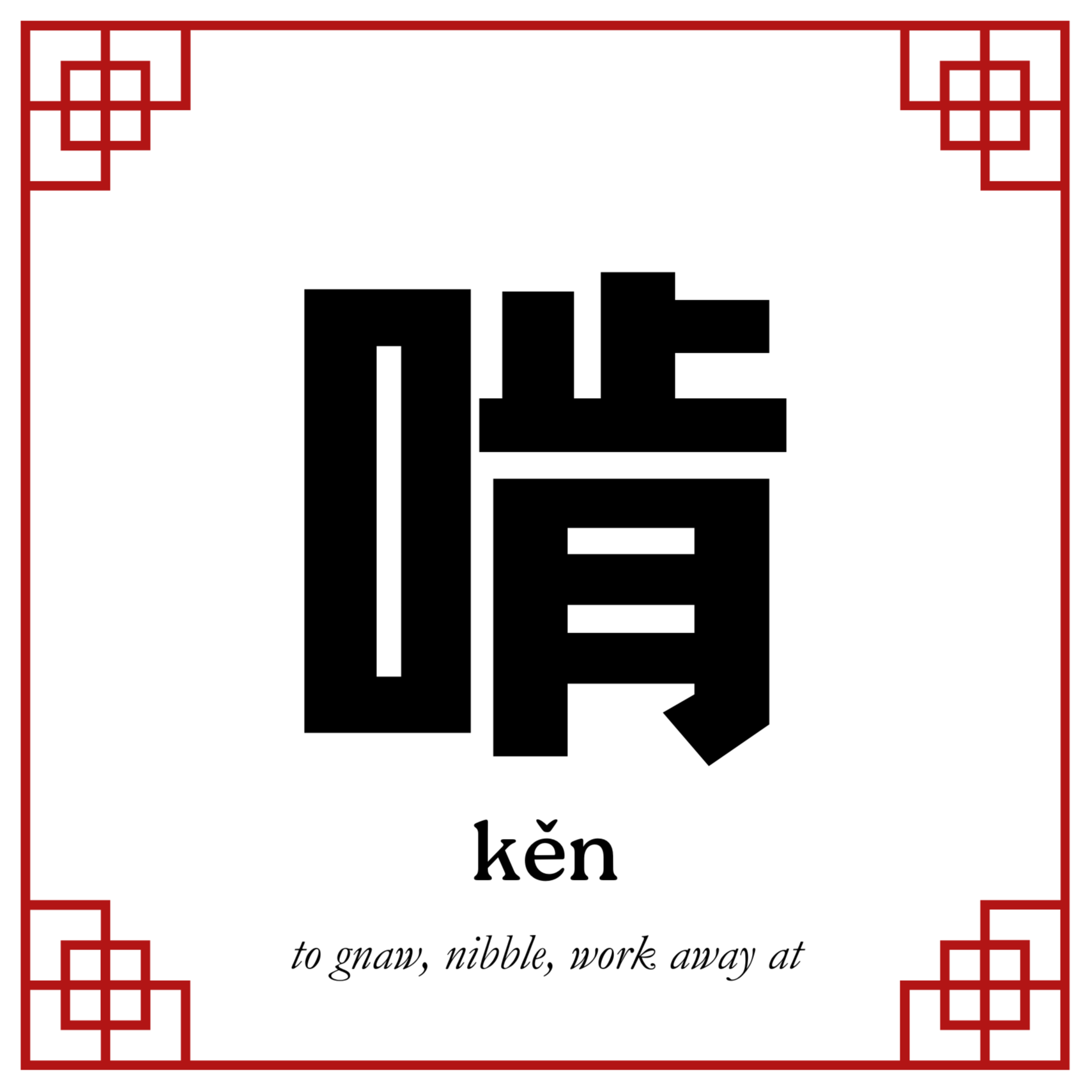
Let’s start with that classic image of a “weird Chinese food”: the chicken’s foot.
Ken is a verb meaning to gnaw or work away at something, usually with your teeth, gradually eating it away rather than simply biting off a mouthful. 啃鸡爪 (ken jizhu) means to gnaw on chicken feet, but the connotation is that it’s a satisfying process: you work around the bones, pulling off little pieces of meat and skin with your teeth. It takes time. That difficulty isn't necessarily an obstacle to eating. Sometimes the work is part of the pleasure.
You can also ken corn on the cob, sugarcane, bone-in meat, or even a slice of watermelon, when you gnaw right down towards the rind. It isn't really a word about the texture of the food itself. It describes the physical act of eating it.
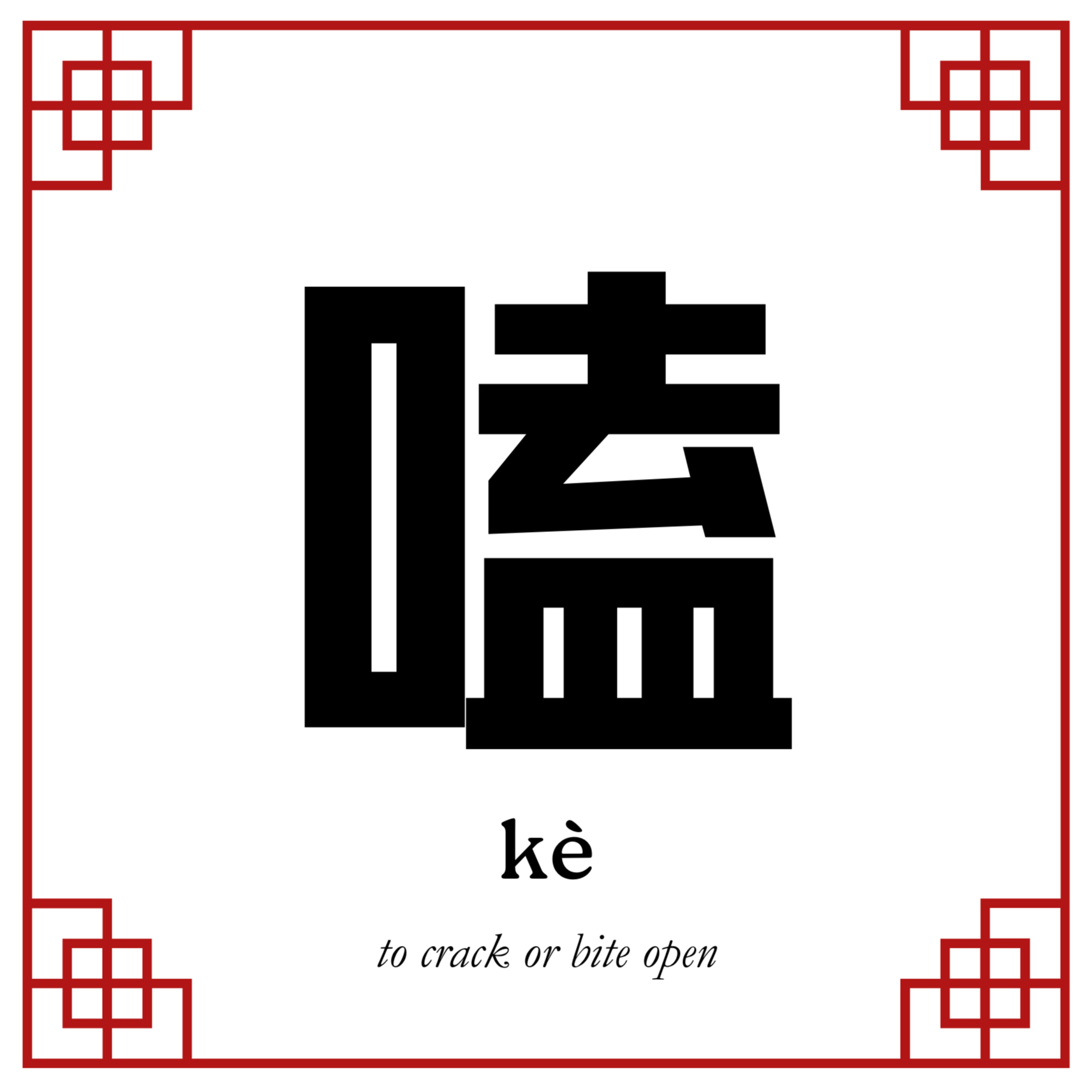
Ke is another very specific eating verb. It describes the act of cracking something hard, often with your teeth, to get at what's inside. It's particularly associated with seeds: sunflower seeds, melon seeds, pumpkin seeds, or shell-on peanuts.
嗑瓜子 (ke guazi) literally means ‘cracking sunflower seeds’ but it’s so much more. It's a leisure activity in its own right: sitting with a bowl of seeds, cracking them open one after another while you chat, gossip, watch TV or hang out with family and friends. Biting sunflower seeds has almost nothing to do with eating. It's a pastime. It’s a repetitive action that many people love: crack, separate the shell, eat the seed, spit out the shell. Then do it again.
WHAT FOOD FEELS LIKE
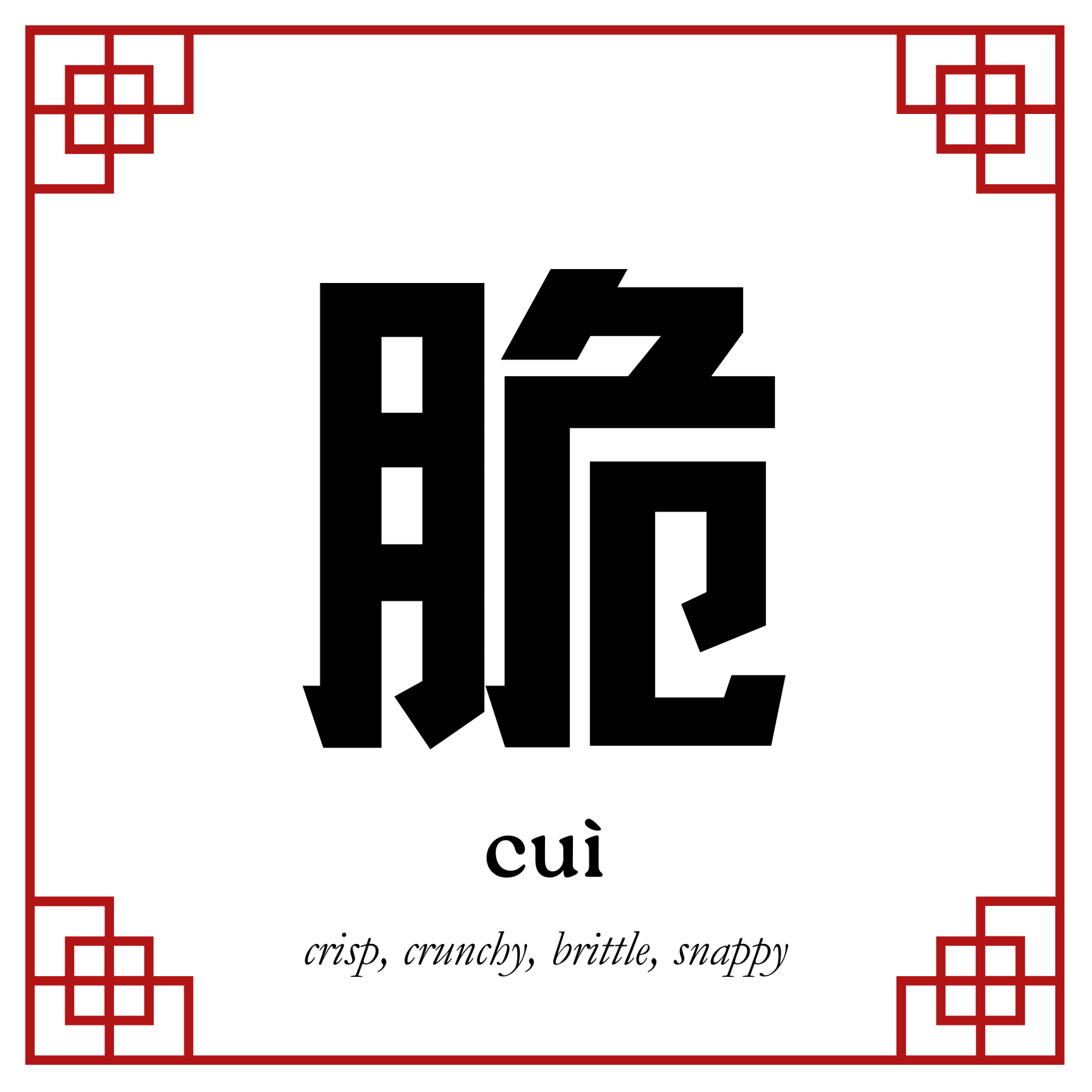
Cui is primarily about the physical quality of the food: something that breaks, cracks or crunches easily when you bite it. It can describe everything from a crisp cucumber or water chestnut to crispy duck skin or a crunchy peanut. But Chinese has lots of ways of getting more specific about what kind of crispness we're talking about.
爽脆 (shuangcui) describes something pleasantly crisp and refreshing, often with a clean, juicy quality. Think cucumber, lotus root, water chestnuts, bean sprouts or jellyfish.
酥脆 (sucui) is crisp and friable, describing things that break apart easily into flakes or crumbs like fried spring rolls, pastries, biscuits or crispy snacks.
And then there's the wonderfully onomatopoeic 嘎嘣脆 (gabengcui), describing something particularly hard and crunchy, with that satisfying loud crack when you bite into it. Peanuts and crackers are good examples.
You can also have 脆嫩 (cuinen): crisp but tender, often used for vegetables that retain some bite while still being delicate.
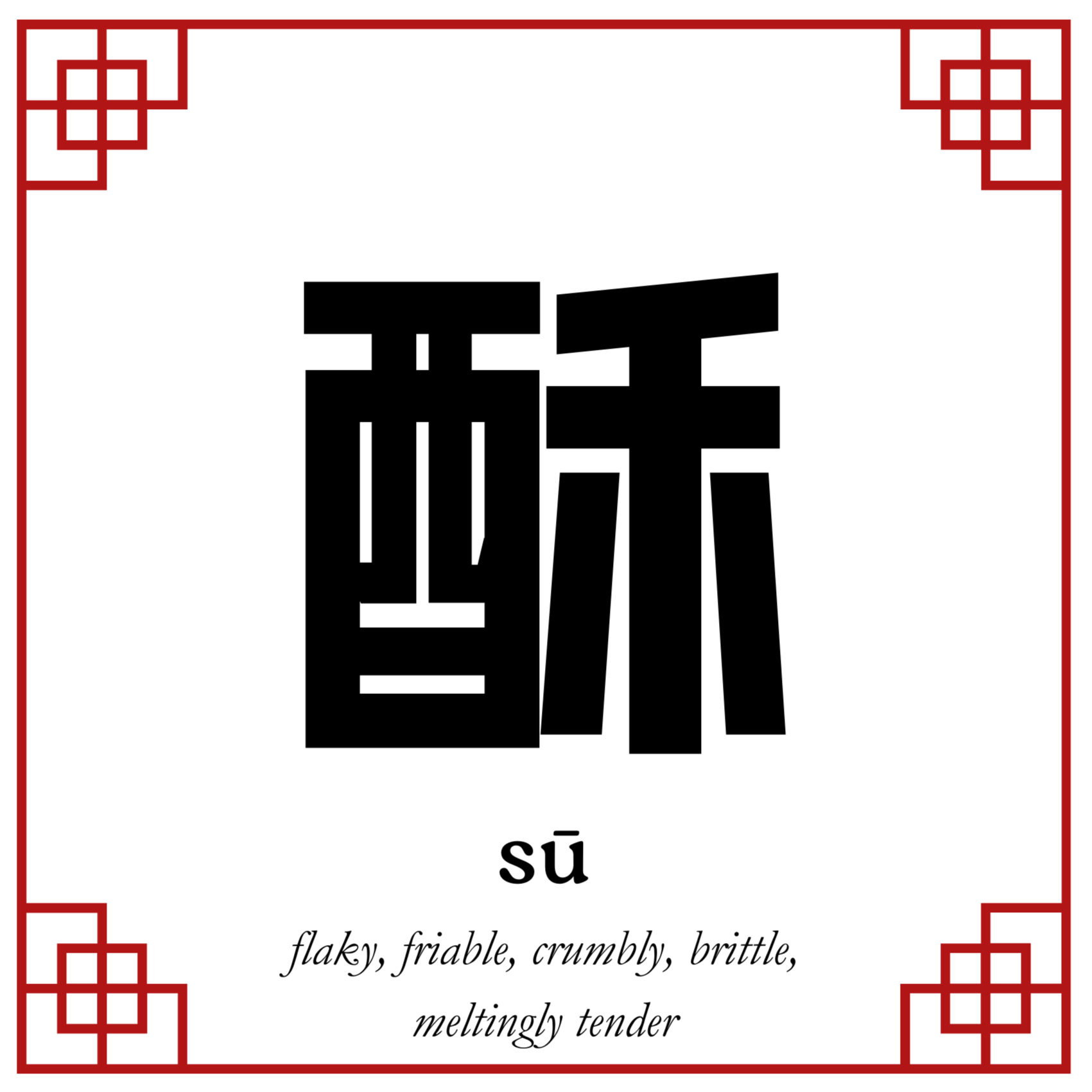
Su is often translated as “crispy”, but that doesn't quite capture it. It describes something flaky, short, crumbly, brittle or tender enough to fall apart easily. Often there's a richness to it from fat, giving that fragile, almost melt-in-the-mouth quality. The important distinction from cui is what happens when you bite it. Cui emphasises the crack or crunch; su suggests something that breaks apart into flakes and crumbs, or becomes so tender that it almost collapses. There are several different uses of su, but two particularly useful ones are:
酥脆 / 酥香 (sucui / suxiang) describe the flaky, crisp, rich side of su: pastries, fried foods, sandy or crumbly Chinese biscuits and other things where fat gives the food a fragile texture.
Then there's 酥烂 / 酥软 (sulan / suruan), where we're almost at the opposite end of the spectrum. Here, su describes meat, bones or vegetables cooked until extremely tender and falling apart. Braised beef brisket, pig's feet cooked until gelatinously soft, or fish cooked until even the bones become soft can all be described this way.
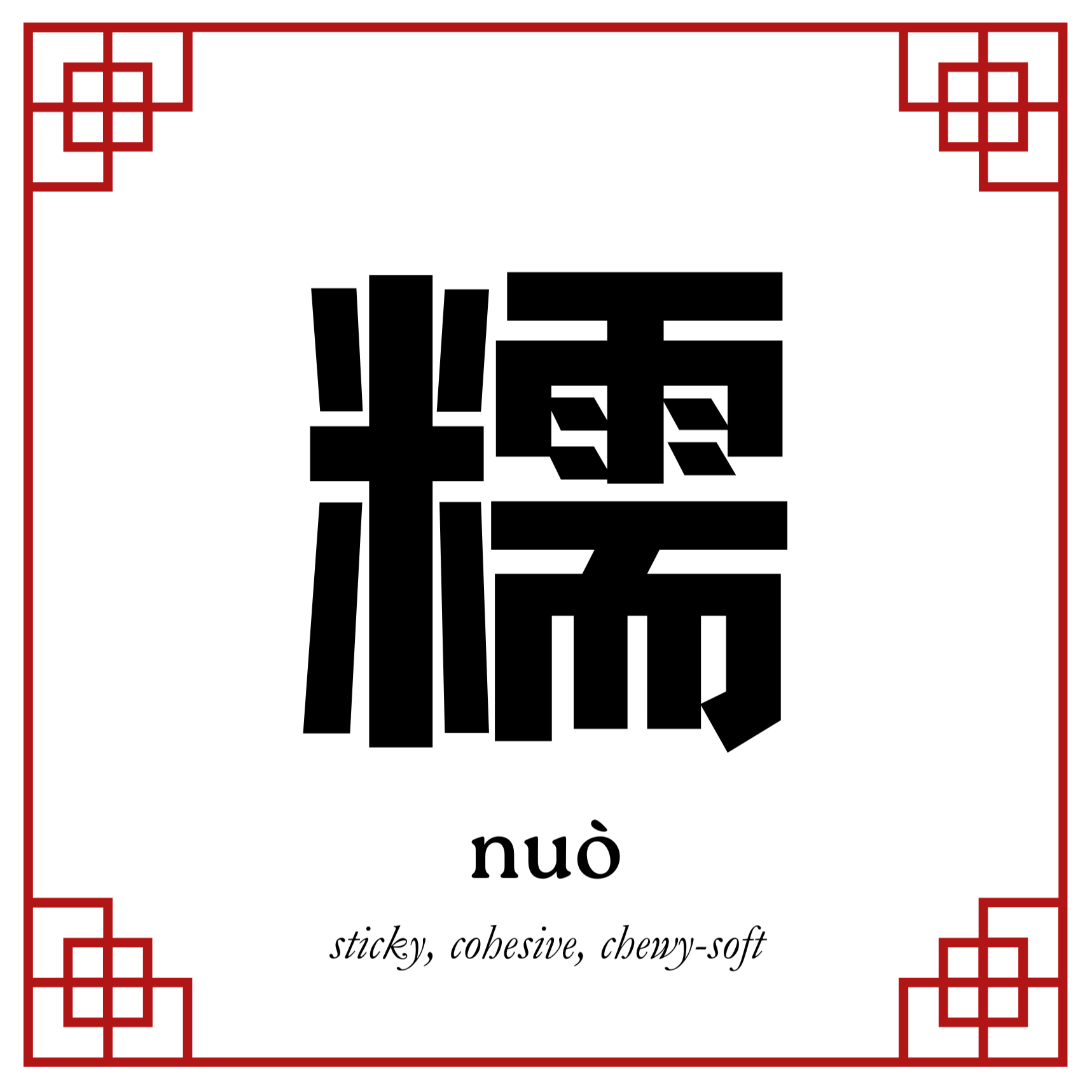
English doesn't really have a single everyday texture word that maps neatly onto nuo. If you've ever eaten glutinous rice, you'll know the texture: soft, cohesive and sticky, with a particular chewy softness that isn't quite gummy and isn't simply mushy.
Most foods described as nuo are made with glutinous rice, or 糯米 (nuomi). 粽子 (zongzi) are pyramid-shaped sticky rice dumplings; 汤圆 (tangyuan) are sweet, stuffed glutinous rice balls served in warm syrup or soup; 年糕 (niangao) is a sticky rice cake; and 青团 (qingtuan) are green glutinous rice balls traditionally made with mugwort and filled with sweet red bean paste, and they’re all made from glutinous rice.
But nuo isn't limited to rice. Taro, yam and cassava can all develop that dense, sticky, starchy quality when steamed or boiled. It's one of those words where English can certainly describe the sensation, but Chinese has a compact, everyday adjective for it.
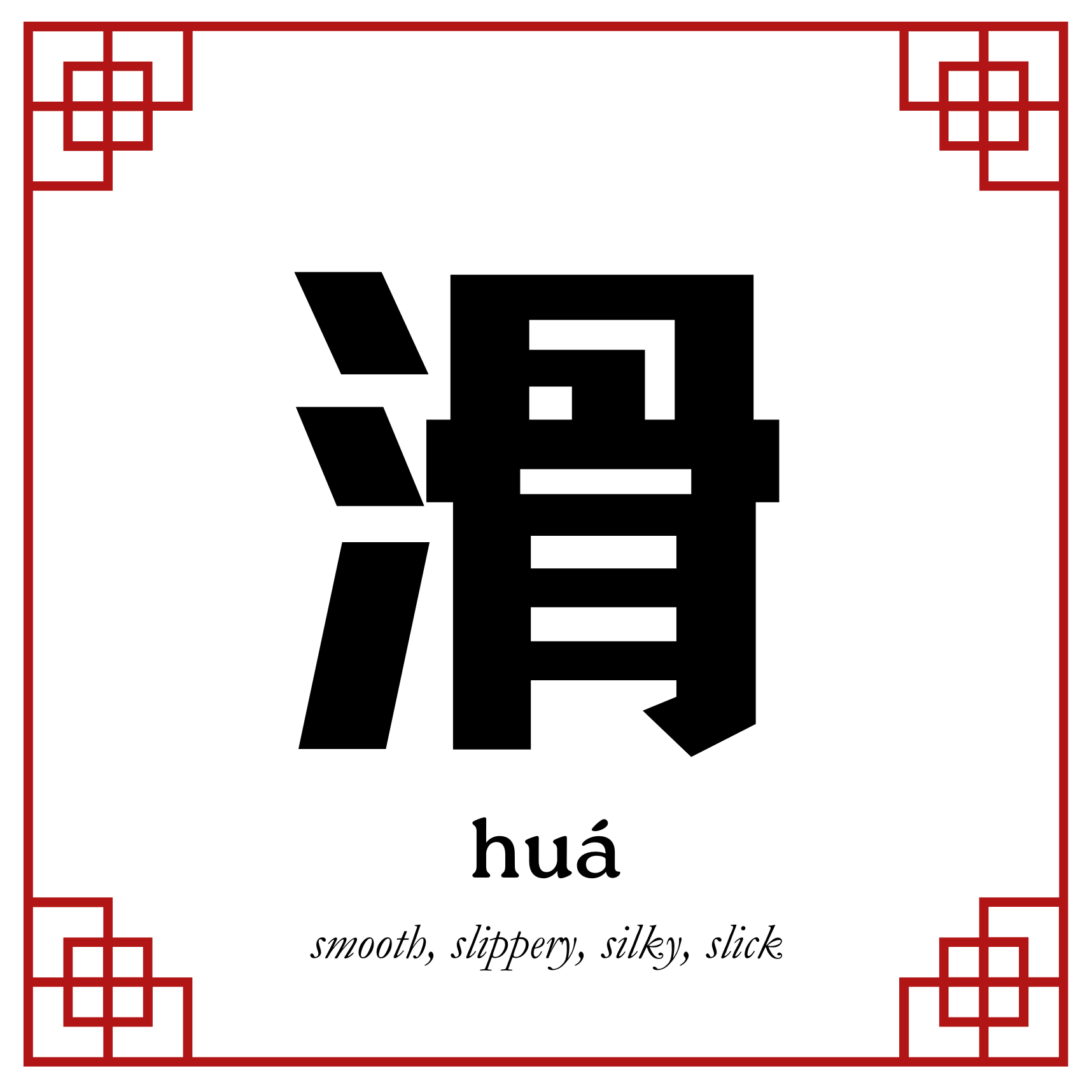
If nuo has a certain resistance and cohesion, hua is about the opposite sensation: food that feels smooth and slippery in the mouth, gliding easily over the tongue and down the throat.Think tofu pudding (dou hua), steamed eggs with a custard-like texture, soft white fish, or certain congees and soups.
But hua doesn't simply mean “slippery” in the slightly unpleasant English sense. In Chinese cooking, it can be a very positive quality, suggesting food that is smooth, moist, tender and easy to swallow. You'll often see it paired with nen (see below) to describe something both silky and tender.
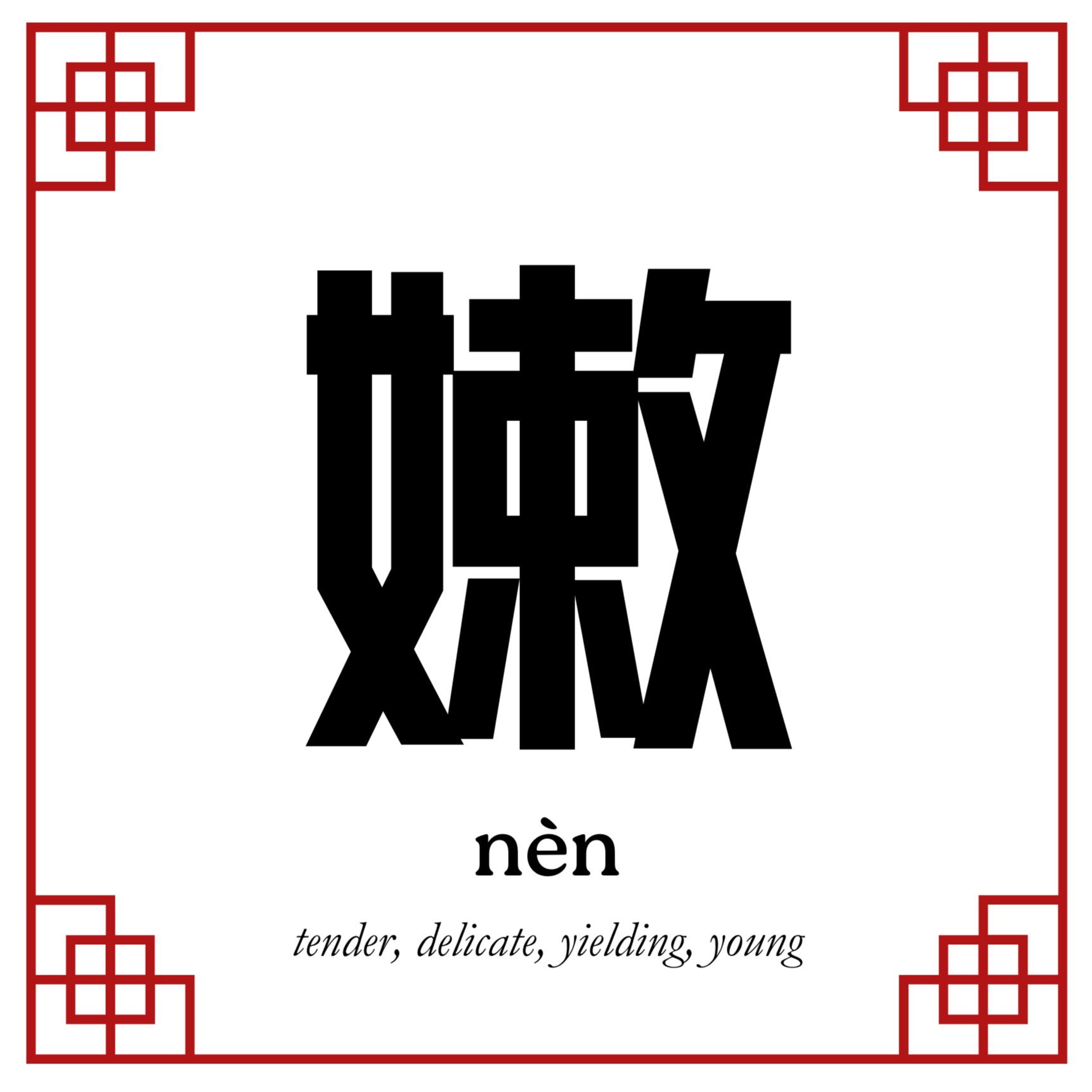
Nen is usually a very positive word in cooking. It describes food that is tender, yielding and pleasant to bite through: soft without being mushy, moist without being watery, and cooked with just the right amount of control. A perfectly steamed fish can be nen, as can velveted beef, poached chicken, young bamboo shoots or spring vegetables.
And it's not only about cooking technique. nen can also describe the natural youth of an ingredient: young shoots, young leaves or other ingredients that haven't yet developed a tougher texture. It's therefore more than simply “soft”. A food can be soft without being nen. The word carries an idea of delicacy, tenderness and, often, getting the texture just right. For many foods, it is quite literally the texture of youth.
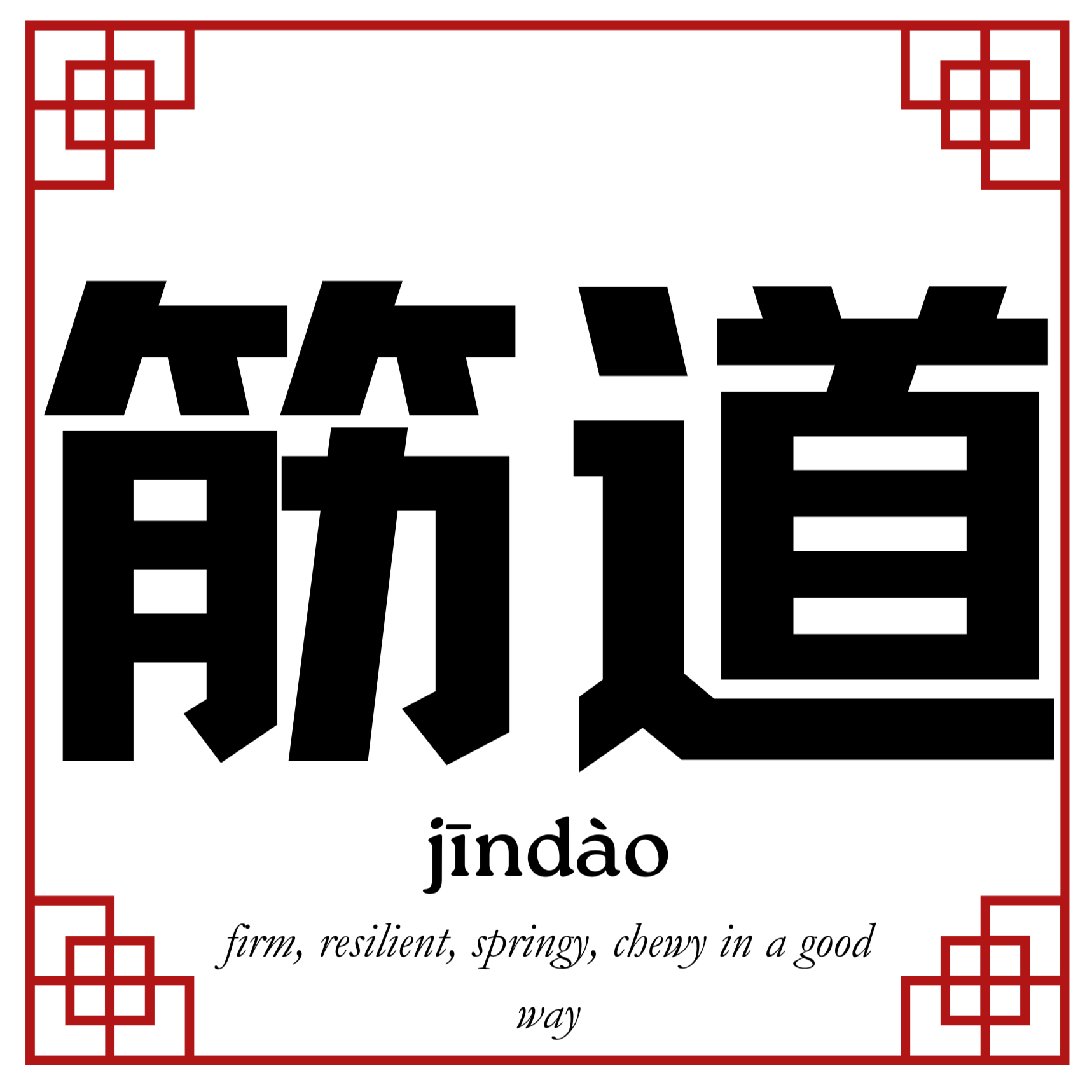
Jindao is closely related to the idea of al dente, especially when talking about noodles. It describes food with a slight bite: there's some resistance under your teeth, you have to chew it a little, and the food holds its shape rather than collapsing. Northern wheat noodles are a perfect example. A well-made hand-pulled noodle or knife-cut noodle can be jindao, with the gluten giving it that satisfying, elastic chew.
You can also use it for other foods with a pleasantly substantial, resilient texture, including some steamed breads and dumpling skins. The first character, 筋, means tendon or sinew, which gives a useful image for the quality being described: something with structure and resistance rather than something soft and yielding.
THE FEELING IN YOUR MOUTH
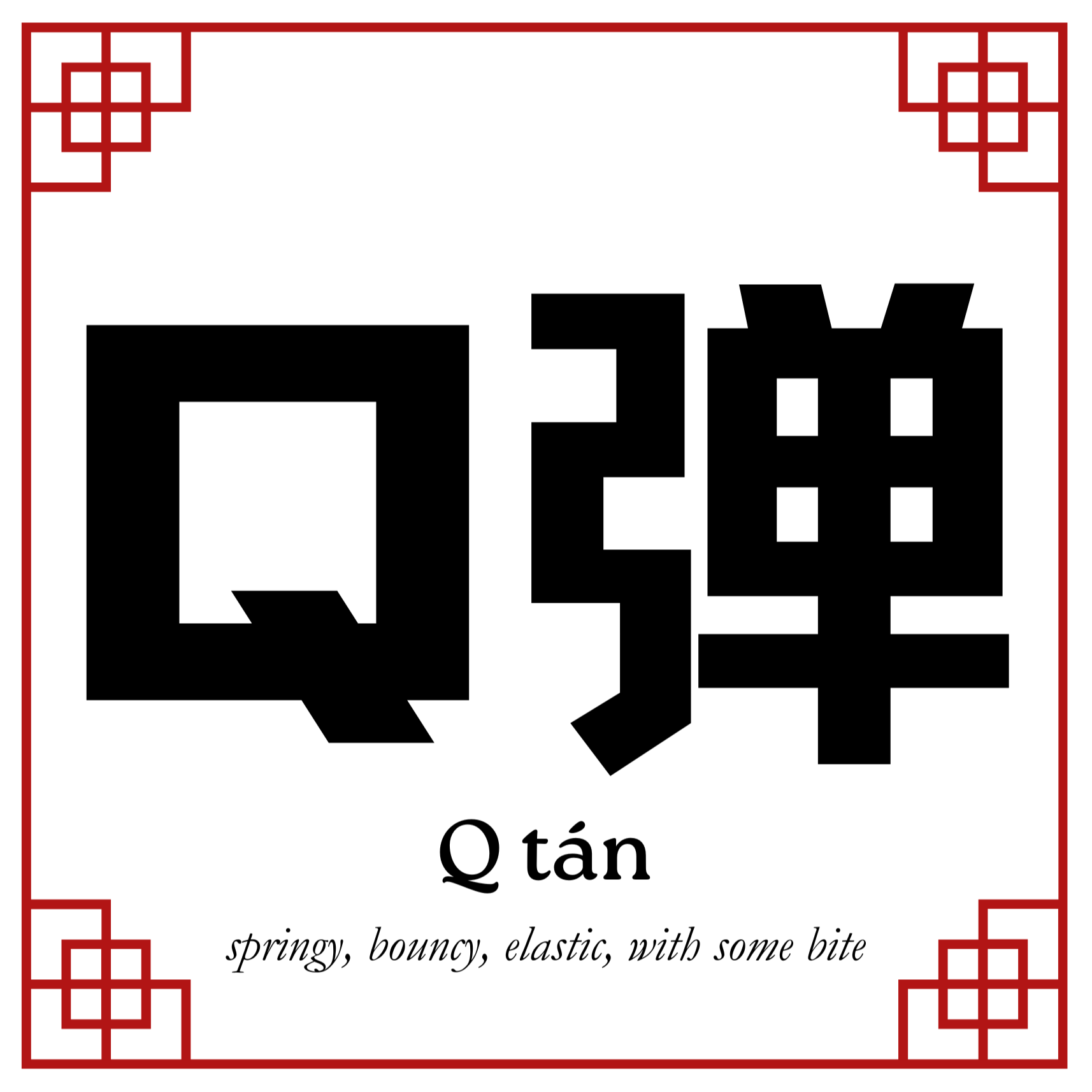
Q tan is one of the most recognisable modern Chinese expressions for texture. The “Q” isn't really a Chinese character with a precise dictionary definition here. It's a colloquial expression that has become part of food and marketing language, particularly for foods with a pleasant, elastic chew.
When you bite something Q tan or QQ, it gives a little resistance and then springs back. It isn't hard, mushy, or tough. The appeal is in that slightly bouncy, elastic quality. Think of the tapioca pearls in bubble tea, fish balls, some noodles, or chewy rice-based foods. Their appeal isn't necessarily their flavour. Sometimes the texture is the whole point.
You'll also see QQ used on its own as a casual way of describing this kind of springy, chewy texture. It's a good example of how Chinese food vocabulary continues to evolve. Unlike some of the older culinary words on this list, Q tan feels distinctly modern, informal and influenced by contemporary food culture.
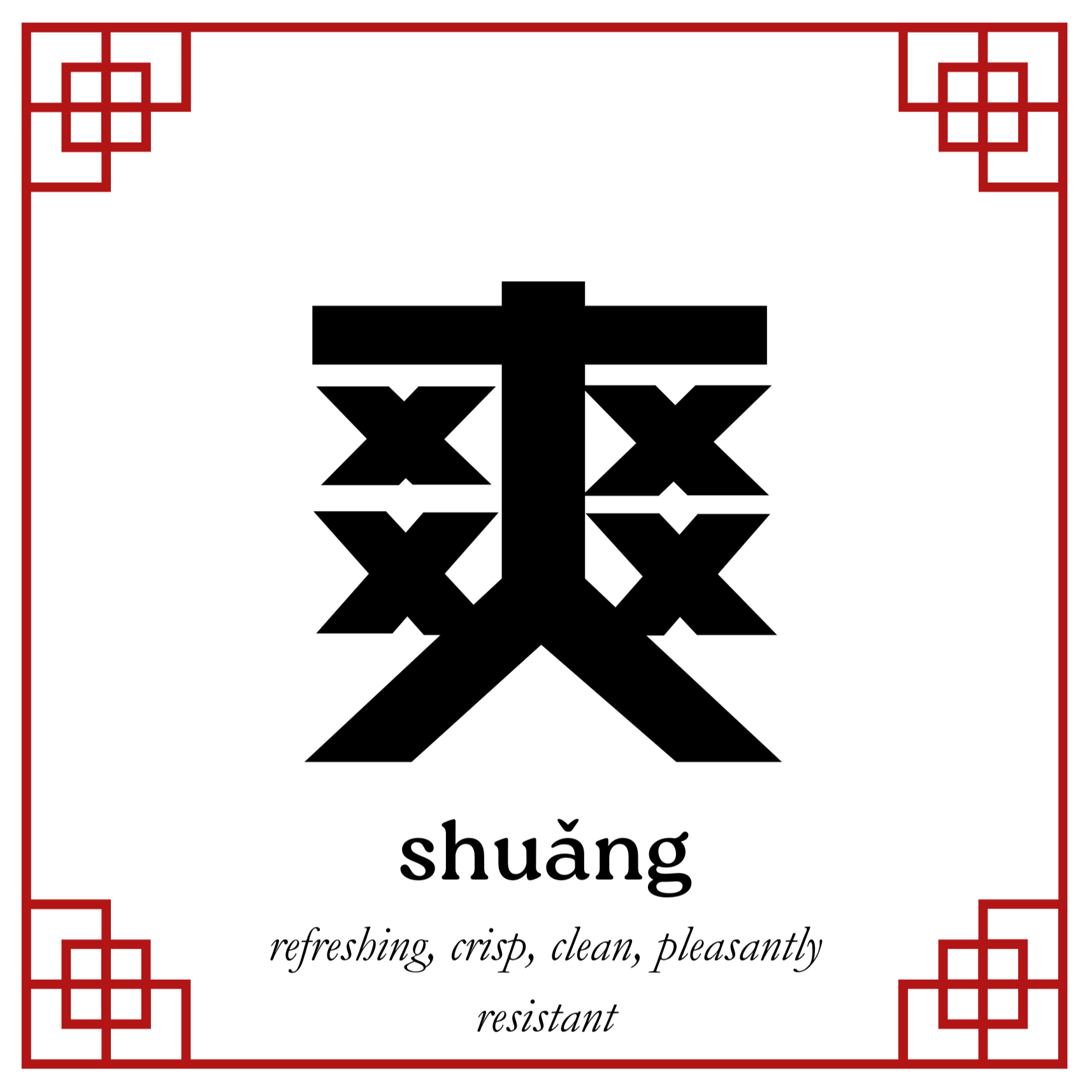
And then we get to one of the hardest words to translate.
Shuang is much broader than simply “crisp”. In food contexts, it can describe something refreshing, clean, pleasantly crisp, or satisfying in the mouth. It is less a texture than an overall sensory reaction: ahhh, that feels good.
A crisp cucumber salad can be shuang. So can biting into a fresh apple or pear.
But then things get more interesting. Jellyfish and wood ear mushrooms can also be described as shuang, despite having completely different textures from an apple. They have that slippery, crisp, slightly resistant quality that makes your mouth feel refreshed rather than weighed down.
This is why shuang and cui overlap but aren't interchangeable. cui is primarily describing what the food physically does when you bite it. shuang can describe the whole sensation that texture creates. That's what makes it tough to translate. Sometimes Chinese food vocabulary isn't just describing the food, it’s describing the pleasure of eating it.